
Sitting prominently at the midpoint of the Royal Mile, St Giles’ Cathedral is the religious focal point of Edinburgh’s Old Town. Technically, it isn’t a cathedral at all—it is the High Kirk of Edinburgh, a Presbyterian parish church that doesn’t have a bishop. However, the “cathedral” title has stuck through centuries of turbulent Scottish history.
Founded in 1124 by King David I, St Giles has been burned by English armies, stripped of its Catholic ornamentation during the Scottish Reformation, and heavily restored by the Victorians. Today, it stands as a working church and a heavily visited historical site.
Whether you are here to trace the footsteps of John Knox or simply want to see the intricate woodwork of the Thistle Chapel, this guide covers the practicalities of visiting St Giles’ Cathedral.
Is St Giles’ Cathedral for You?

Edinburgh Castle
Navigate Scotland's most famous fortress without getting stuck in the crowds.

Palace of Holyroodhouse
Explore the official Scottish residence of the British monarch, from the dramatic chambers of Mary, Queen of Scots, to the ruined nave of Holyrood Abbey.
Because St Giles sits directly on the walking route between Edinburgh Castle and the Palace of Holyroodhouse, almost everyone passes its doors. Here is how to approach a visit based on your travel style:
- For the Time-Poor: You only need about 20 to 30 minutes to walk the perimeter of the nave, step into the Thistle Chapel, and view the main stained-glass windows. It is an easy, low-commitment stop.
- For Budget Travelers: Entry is free, though a donation of £5 is strongly encouraged to help with upkeep. It remains one of the best free historical sites in the city center.
- For Families: While it is a quiet, contemplative space, older children might enjoy a scavenger hunt for the quirky carvings in the Thistle Chapel (look for the angel playing the bagpipes) or finding John Knox’s grave, which is bizarrely located under parking space number 23 in the square outside.
5 Interior Structural Highlights
St Giles is a patchwork of architectural styles. Because it was expanded haphazardly by wealthy merchant guilds over centuries, the interior lacks the uniform symmetry of traditional English or French Gothic cathedrals. Instead, it offers a maze of side aisles and chapels.
Here are the five structural and historical highlights to look for once you step inside.
1. The Thistle Chapel
Tucked away in the southeast corner of the church, the Thistle Chapel is the undisputed highlight of St Giles. Built in 1911, it serves as the spiritual home of the Most Ancient and Most Noble Order of the Thistle, Scotland’s highest order of chivalry (the Scottish equivalent to England’s Order of the Garter).
The chapel is tiny but overwhelmingly detailed. The walls are lined with intricately carved oak stalls assigned to the 16 knights of the order, topped with their heraldic crests and helms.
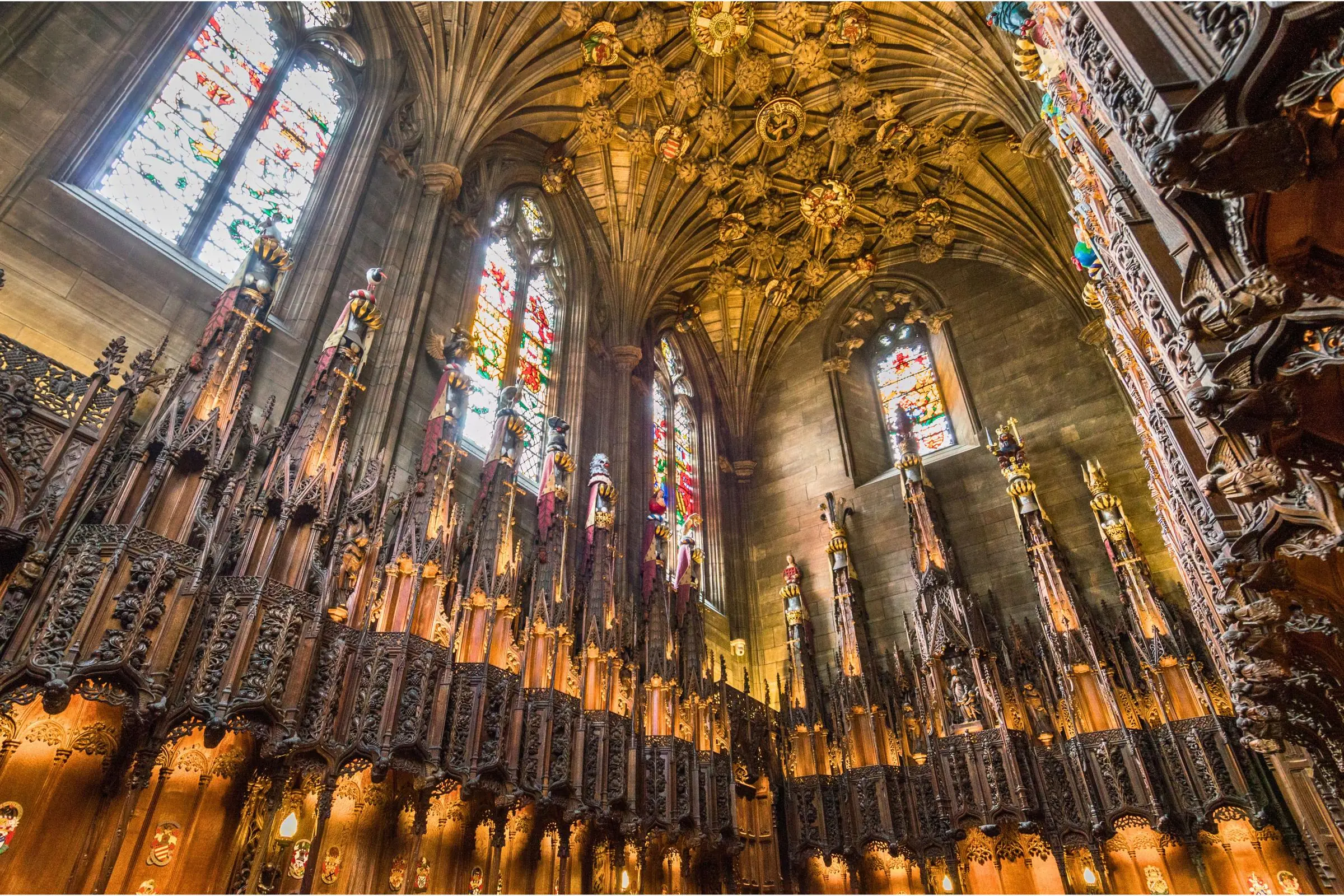
Look Up: The vaulted ceiling is a masterpiece of stone boss carving. Bring binoculars or zoom in with your camera to spot the famous “bagpipe angel” carved into the woodwork near the entrance.
2. The Stained-Glass Windows
During the Scottish Reformation in 1560, John Knox and his followers stripped St Giles of its Catholic decorations, including its original stained glass, favoring plain, clear windows to focus the congregation on the sermon.
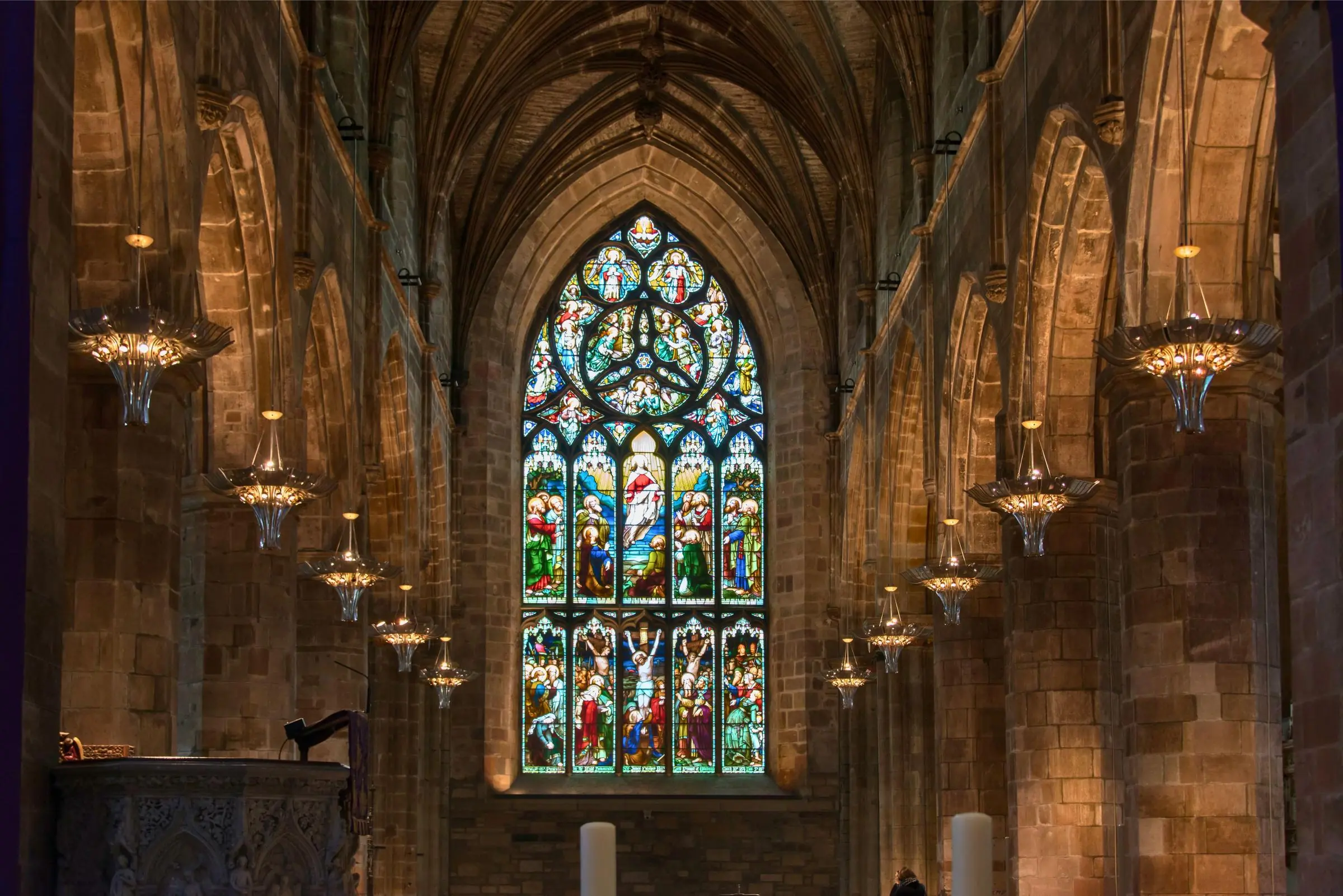
The vibrant glass you see today is almost entirely Victorian. In the late 19th century, the church began reinstalling stained glass to soften the austere interior.
- The Great East Window: Installed in 1873, this massive window depicts the crucifixion and ascension of Christ.
- The Robert Burns Window: Located in the south aisle, this modern window (installed in 1985) pays tribute to Scotland’s national poet with themes of nature and human brotherhood.
3. The Crown Spire
While you can’t access the spire from the inside, it is the defining structural feature of the building. Added around 1495, the spire is shaped like a crown, supported by eight flying buttresses that meet at the top. It was built to reflect Scotland’s independent status and the monarch’s imperial crown.
You will get the best view of the Crown Spire from the street level on the Royal Mile, or by looking down on the city from Calton Hill.
4. The John Knox Statue
John Knox, the fiery leader of the Scottish Reformation, served as the minister of St Giles from 1559 to 1572. He preached from this very building, famously bringing Mary, Queen of Scots to tears with his harsh sermons.
Inside the nave, you will find a bronze statue of Knox created by Pittendrigh MacGillivray in 1904. It portrays him mid-sermon, Bible in hand, leaning forward aggressively.
Note: Do not confuse the statue with his grave. Knox was buried in the churchyard outside, which was later paved over. You can find a small brass plaque marking his approximate resting place in parking space 23 behind the cathedral.
5. Historical Vaults and Aisles
Unlike traditional crypts, the “vaults” of St Giles are mostly above ground in the form of enclosed aisles built by wealthy families.
- The Albany Aisle: Built in the early 15th century, this section features a rare surviving medieval stone vaulted ceiling.
- The Chepman Aisle: Contains the tomb of James Graham, the 1st Marquess of Montrose, a Royalist hero executed in 1650. His elaborate Victorian monument is one of the grandest in the church.
Keep Planning: If you are looking for the dark, subterranean vaults famous for ghost stories, those are the South Bridge vaults located a few streets away. You can explore them by booking the Blair Street Underground Vaults Tour.
Entry Options: Free Visits vs. Guided Tours
St Giles’ Cathedral operates as a working parish church, meaning general entry is free, though visitor donations are heavily relied upon to keep the doors open.
Option 1: Independent Visit (Donation)
You can walk in during opening hours and explore at your own pace. There are volunteer guides stationed throughout the building (often wearing blue robes or lanyards) who are happy to answer questions for free.
- Cost: Free (Suggested £5 donation).
- Best for: Budget travelers, quick stops, and those who prefer to wander.
Historically, St Giles required visitors to purchase a £2 photography permit to take pictures inside. They have recently relaxed this rule, allowing free photography (no flash, no tripods), but they still encourage a donation if you plan to take extensive photos.
Option 2: Walking Tours
Because St Giles is the historical anchor of the Royal Mile, almost every comprehensive Old Town walking tour includes a detailed stop here. Taking a guided tour provides vital context about the Scottish Reformation and the Covenanters that you won’t get just by looking at the walls.
Old Town History and Tales Walking Tour
- 2-hour guided walking tour of the Old Town.
- Includes historical context of St Giles’ Cathedral and John Knox.
- Explores the closes and wynds of the Royal Mile.
Royal Mile Guided Walking Tour
- 1.5-hour focus specifically on the Royal Mile.
- Covers the exterior architecture of St Giles and the Mercat Cross.
- Good for those with limited time.
Our Verdict: DIY or Guided?
- DIY: Free and flexible. You can spend 10 minutes or an hour.
- Guided: A local guide brings the complex, bloody history of the Scottish Reformation to life, explaining why the church looks the way it does.
- DIY: The signage inside is minimal; you miss the historical context.
- Guided: You are tied to a group schedule and may not get extended time inside the Thistle Chapel.
Logistics: Getting There & Practical Tips
Transit and Location
St Giles’ Cathedral is located on the High Street section of the Royal Mile (Parliament Square, Edinburgh EH1 1RE).
- Walking: It is a steep 5-minute walk up from Waverley Train Station via the Playfair Steps and Milne’s Court, or a 10-minute walk down from Edinburgh Castle.
- Bus: Lothian Buses 23, 27, 41, and 42 stop on nearby George IV Bridge. From there, it is a flat 3-minute walk to the cathedral.
- Accessibility: The main entrance has ramp access. The interior is mostly flat, though the Thistle Chapel has a couple of steps and is quite narrow, making wheelchair access difficult in that specific room.
Local Tips for Visiting
- Avoid Sunday Mornings: As a working church, St Giles holds regular Sunday services. Tourist access is restricted during worship (usually between 9:30 AM and 12:30 PM).
- The Thistle Chapel Queue: The chapel is very small and can only hold about 15 people at a time. In the peak summer months (July/August), a queue forms inside the cathedral just to enter the chapel. Visit right at opening time (usually 10:00 AM) to avoid the wait.
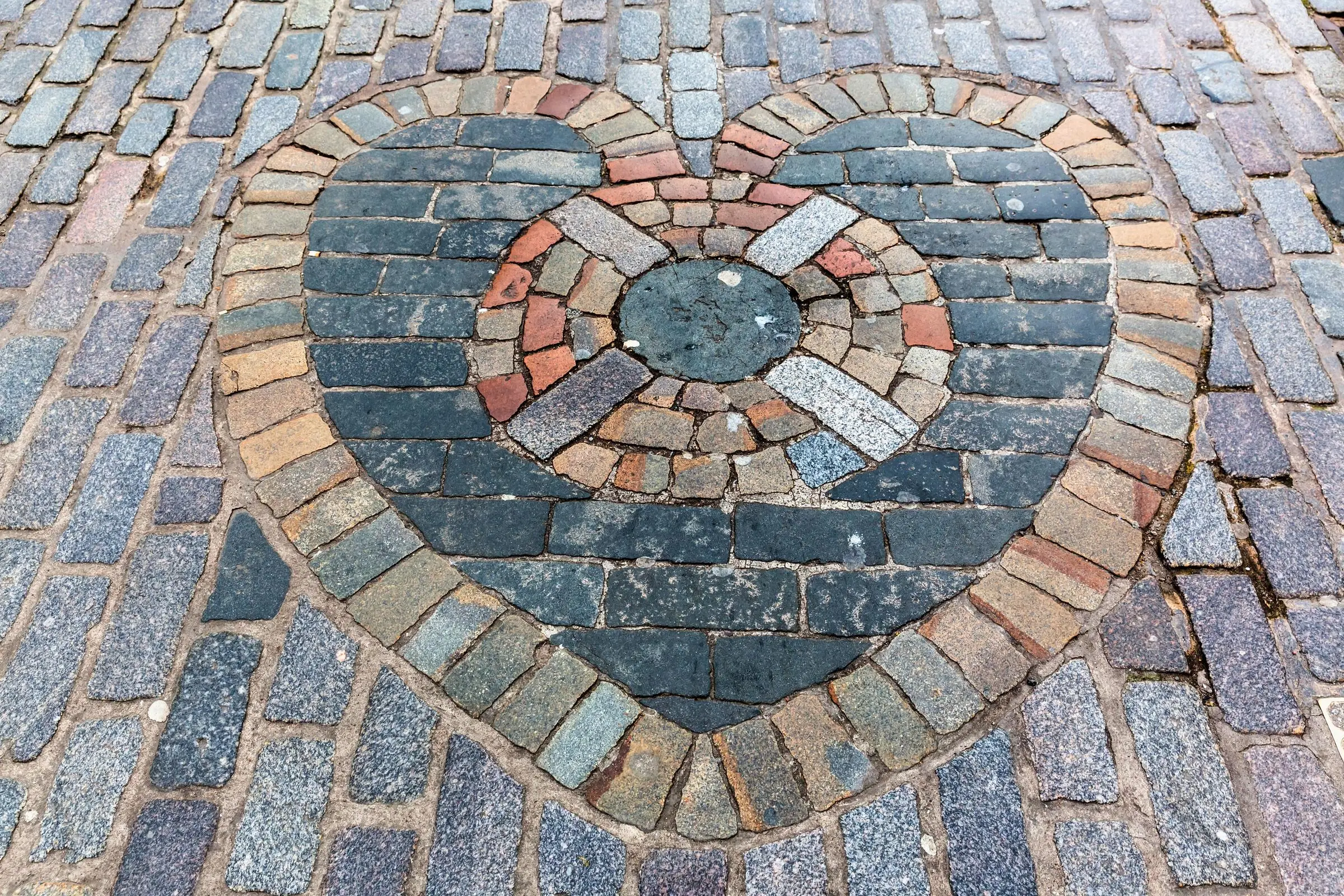
- Look for the Heart of Midlothian: Just outside the west door of the cathedral, look down at the cobblestones to find a heart shape built into the pavement. This marks the site of the Old Tolbooth (a notorious prison). Locals traditionally spit on the heart for good luck—watch your step!
Where to Stay Near St Giles
Staying near St Giles puts you in the absolute center of the Old Town. It is incredibly convenient for sightseeing, but be aware that the Royal Mile gets very noisy during the August festivals and on weekend nights.
Frequently Asked Questions
Is St Giles' Cathedral actually a cathedral?
Technically, no. It is the High Kirk of Edinburgh. It was briefly a cathedral (the seat of a bishop) twice in the 17th century when the Crown tried to force episcopacy on Scotland, but it has been a Presbyterian parish church for most of its post-Reformation history.
How much does it cost to enter St Giles' Cathedral?
Entry is free, but the church relies heavily on visitor donations to maintain the historic building. A donation of £5 per person is suggested at the welcome desks.
Can you go up the Crown Spire?
No, the Crown Spire is not open to the public for safety and structural reasons. You can only view it from the outside.
Where is John Knox buried?
John Knox is buried in what used to be the churchyard of St Giles. Today, that area is paved over and serves as a parking lot for the High Court. His grave is marked by a small brass plaque in parking space number 23.
Are there public toilets inside St Giles?
No, there are no public toilets inside the cathedral. The nearest public facilities are located a short walk away on the Royal Mile or inside nearby cafes and museums (like the National Museum of Scotland).
Is the Thistle Chapel always open?
The Thistle Chapel is usually open during standard visitor hours, but it may close occasionally for private ceremonies, cleaning, or if volunteer staffing is short. It is best to visit mid-morning for the highest chance of access.
Explore More of the Royal Mile
To fully understand the bloody history of the Scottish Reformation and the secrets of the Royal Mile, consider joining a local historian for a guided walk through Edinburgh’s Old Town.