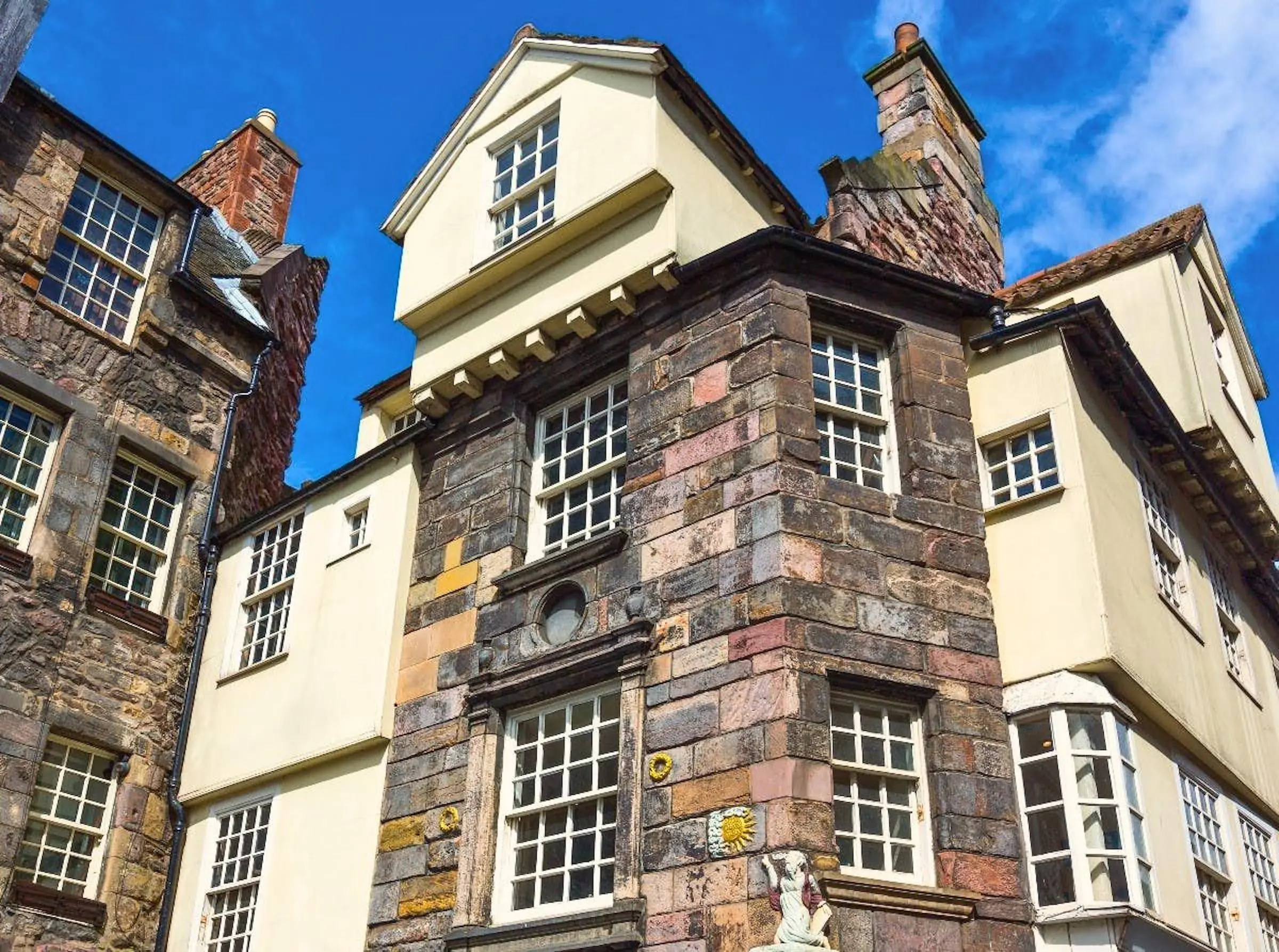
Jutting out into the middle of the Royal Mile, John Knox House is impossible to miss. With its timber-framed galleries, external stone staircases, and red pantile roof, it looks entirely out of place among the taller, more uniform stone tenements of Edinburgh’s Old Town.
Dating back to 1470, this is one of the oldest surviving residential buildings in the city. While it is famous for its association with John Knox, the fiery Protestant reformer who lived here briefly before his death in 1572, the house actually tells a much broader story. It was owned by James Mossman, a Catholic goldsmith fiercely loyal to Mary, Queen of Scots.
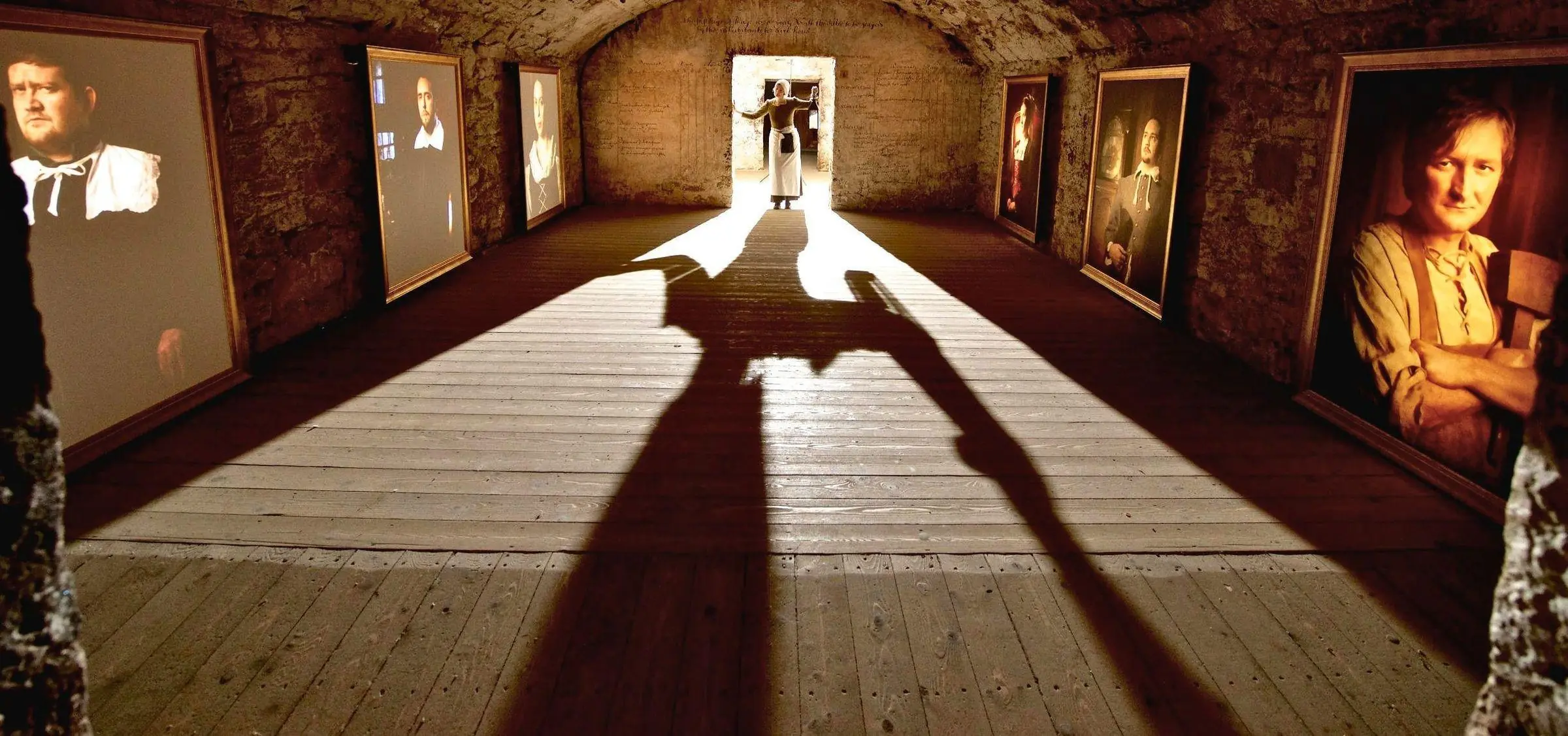
Today, the building serves as a museum dedicated to both men, offering a rare, tangible look at domestic life in 16th-century Edinburgh. If you want to understand the turbulent era of the Scottish Reformation, or if you simply want to walk across 500-year-old creaking floorboards, an entry ticket is well worth the modest price.
Historical Significance: A Tale of Two Enemies
The history of John Knox House is defined by two men on opposite sides of a religious and political war.
James Mossman was the wealthy goldsmith who owned the house in the mid-16th century. He was a staunch Catholic and a loyalist to Mary, Queen of Scots. During the “Lang Siege” (1571–1573), when forces loyal to the exiled Queen held Edinburgh Castle, Mossman was inside minting coins to fund their defense. When the castle finally fell, Mossman was captured and executed for treason.
John Knox, on the other hand, was the leading figure of the Scottish Reformation. He was a radical Protestant minister who frequently clashed with Mary, Queen of Scots, famously reducing her to tears during their debates. Knox is believed to have lived in this house for only a few months in 1572, right before his death, while he was the minister of nearby St Giles’ Cathedral.
Ironically, it was the brief association with Knox that saved the building. In the 1840s, the city planned to demolish the house to widen the street. The Free Church of Scotland intervened, arguing that the home of their founding father must be preserved. Mossman’s legacy was largely ignored at the time, but the museum today does an excellent job of telling both sides of the story.
5 Architectural & Interior Highlights
John Knox House is a labyrinth of small rooms, uneven floors, and low ceilings. It is a prime example of medieval Scottish burgh architecture. Here are five specific details to look for during your visit.
1. The Painted Ceiling in the Oak Room
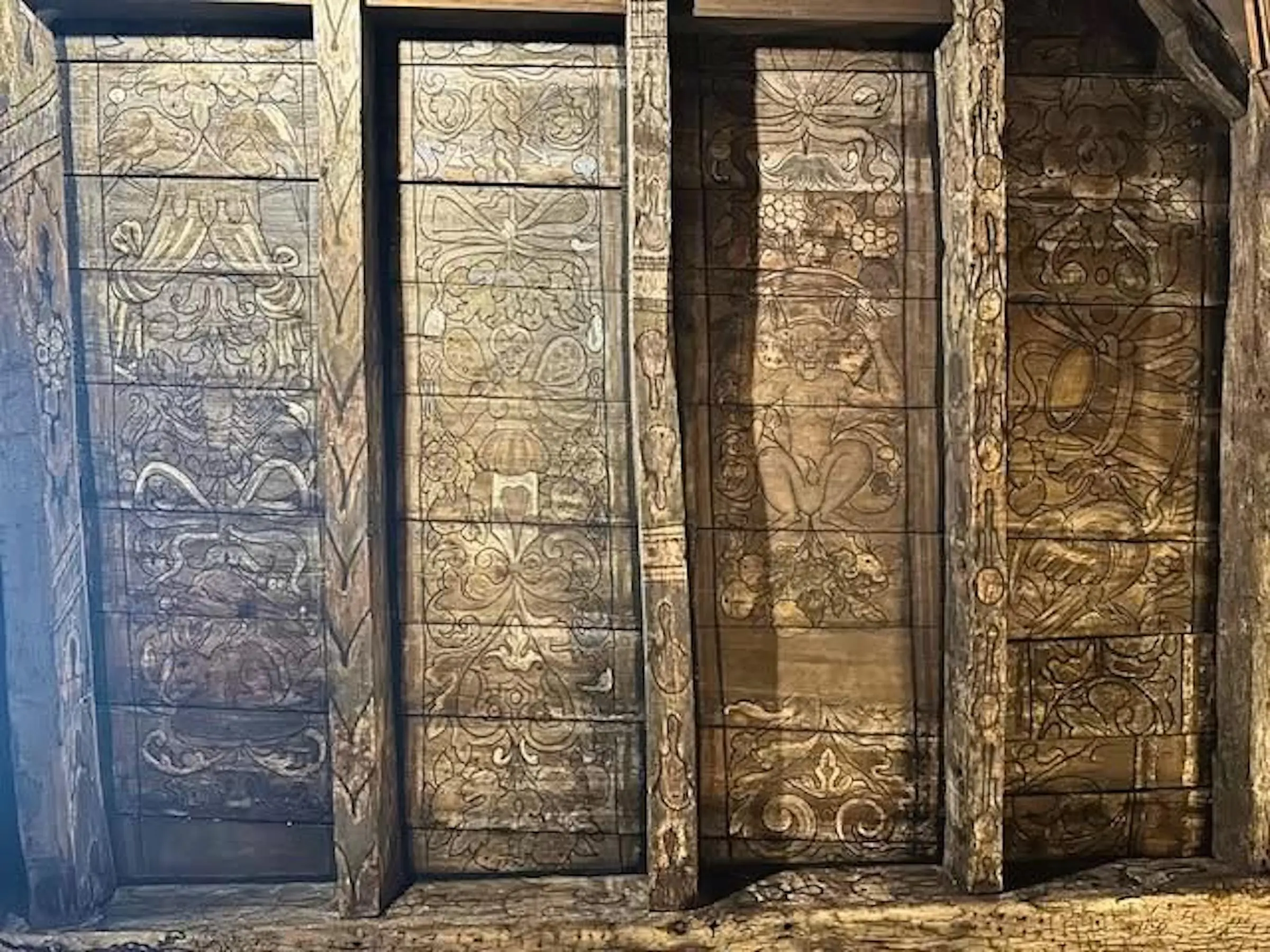
On the second floor, look up. The Oak Room features a spectacular painted timber ceiling dating back to the early 1600s. The ceiling is decorated with intricate floral patterns, mythical beasts, and astrological symbols. It was hidden under plaster for centuries and only rediscovered during restoration work. The colors have faded, but the detail remains remarkably intact.
2. The Projecting Galleries (Luckenbooths)
From the outside, you’ll notice the wooden galleries that project out over the street. In medieval Edinburgh, space within the defensive city walls was at a premium. To maximize square footage, residents built outward, encroaching on the public street. These extensions, sometimes called luckenbooths (locked booths) on the ground floor, were used as shop fronts. Mossman would have operated his goldsmith business from the ground level here.
3. The Mossman Coat of Arms
Before you even enter the building, look at the exterior stone wall facing the street. You will see a carved stone panel featuring the coat of arms of James Mossman and his wife, Mariota Arres. It is accompanied by an inscription that reads: “Lufe God abufe al and yi nychtbour as yi self” (Love God above all and thy neighbor as thyself).
4. The Time Capsule Window
During a Victorian-era restoration, workers found a small “time capsule” hidden in the walls, containing items from the 1800s. The museum has continued this tradition. In one of the upper rooms, there is a small window cut into the wall where modern items have been placed for future generations to find.
5. The “Turnpike” Staircase
To move between floors, you have to climb a narrow, winding stone staircase known as a turnpike stair. Notice how the steps are uneven in height. This was a deliberate defensive feature common in medieval Scottish homes, known as a “trip step.” The owner, familiar with the stairs, could run up them easily in the dark, while an invading attacker would inevitably trip.
Ticket Options & Logistics
John Knox House is managed by the Scottish Storytelling Centre, which is attached to the modern building next door. You enter through the modern center to buy tickets and access the historic house.
John Knox House: Entry Ticket
- Full access to all floors of the historic house
- Audio guide available via smartphone
- Excellent value for a 45-minute visit
Royal Mile Guided Walking Tour
- 2-hour guided walk down the Royal Mile
- Covers the exterior history of John Knox House
- Does not include interior entry tickets
While John Knox House rarely sells out completely, the interior capacity is strictly limited due to fire regulations in the medieval timber structure. Booking your entry ticket in advance guarantees you won’t have to wait in the modern lobby during peak summer months.
Audience Segmentation: Is it right for you?
For the Time-Poor: If you only have a few days in Edinburgh, John Knox House is highly efficient. It sits exactly halfway between the Castle and the Palace of Holyroodhouse. You can thoroughly explore the house in 45 minutes.
For Families: Older kids usually enjoy the spooky, creaky atmosphere of the old house. The museum provides a “dragon hunt” activity sheet to keep children engaged while parents read the historical plaques. Warning: This attraction is a nightmare for strollers. You will need to leave your buggy in the modern Storytelling Centre lobby and carry infants up the steep, narrow stairs.
For Accessibility Needs:
Due to the historic nature of the 15th-century building, John Knox House is not wheelchair accessible. The only way to explore the upper floors is via steep, uneven stone and wooden staircases. The ground floor Scottish Storytelling Centre (including the cafe and toilets) is fully accessible.
For History Buffs: If you have an interest in the Reformation, Mary Queen of Scots, or medieval architecture, this is a mandatory stop. It pairs perfectly with a visit to The Real Mary King’s Close, which shows the underground tenement life of the same era.
Transit Paths: How to Get There
John Knox House is located at 43-45 High Street (the Royal Mile), Edinburgh, EH1 1SR.
Walking from Waverley Station: The house is a 5 to 7-minute walk from Edinburgh Waverley. Exit the station onto Market Street and walk up Cockburn Street. Cockburn Street curves uphill and meets the Royal Mile. Turn left, and you will see the projecting galleries of John Knox House about 100 meters down the street.
By Bus: If you want to avoid the steep hills of the Old Town, you can take the Lothian Bus Route 35, which runs directly down the Royal Mile and stops just a few steps from the house. Alternatively, the Hop-on Hop-off Bus stops nearby at the Museum of Childhood.
By Tram: The closest tram stop is St Andrew Square in the New Town. From there, it is a 10-minute walk across North Bridge and down the Royal Mile.
Keep Planning: For a complete breakdown of getting around the city, read our guide to Edinburgh Public Transport.
Crowd Avoidance & Local Tips
Because the rooms inside John Knox House are small and the staircases are narrow, it can feel claustrophobic if you get stuck behind a large tour group.
- Best Time to Visit: The house opens at 10:00 AM. Arrive right at opening, or wait until after 3:00 PM. The middle of the day (11:30 AM to 2:00 PM) is when the Royal Mile is at its most congested.
- The Cafe: The Scottish Storytelling Centre attached to the house has an excellent, airy cafe. It’s a great spot to grab a flat white and a scone while looking out the large glass windows onto the Royal Mile. It also offers clean, free public restrooms.
- Look for the Bells: As you walk through the house, look for the small bells attached to the walls. These were used to summon servants from the lower floors.
- Mind Your Head: The doorframes in the 15th century were built for much shorter people. If you are over 5’8” (1.7m), you will need to duck frequently.
Where to Stay Near John Knox House
Staying near John Knox House puts you right in the center of the Old Town. You are steps away from the Royal Mile, the National Museum of Scotland, and Waverley Station. However, be aware that this area can be noisy during the August festivals.
Frequently Asked Questions
How long does it take to visit John Knox House?
Most visitors spend between 45 minutes and 1 hour exploring the house. The self-guided nature of the museum allows you to move at your own pace, but the building is relatively small.
Did John Knox actually live there?
Yes, but only briefly. Historical evidence suggests he lived in the house for just a few months in 1572, shortly before his death. The house was primarily owned by James Mossman, a goldsmith to Mary, Queen of Scots.
Is John Knox House included in the Edinburgh Pass?
No, John Knox House is usually not included in the standard city passes. However, the entry ticket is very affordable at around £7.00.
Are there guided tours available inside the house?
The interior of the house is self-guided. You are provided with an information booklet, and there are detailed plaques in every room. You can also access an audio guide via your smartphone. If you want a guided experience of the area, you should book a Royal Mile Walking Tour.
Can I take photos inside?
Yes, photography without flash is permitted throughout the house. The Painted Ceiling in the Oak Room and the views looking down onto the Royal Mile from the upper windows are the best photo opportunities.
Is there luggage storage at John Knox House?
No, there are no lockers or luggage storage facilities on site. Because the staircases are incredibly narrow, you cannot bring large backpacks or suitcases into the historic house. You will need to use a luggage storage service at nearby Waverley Station.
Ready to explore Edinburgh's medieval history?
Don’t miss the chance to walk through one of the oldest surviving buildings on the Royal Mile. Secure your entry tickets in advance to guarantee your spot.