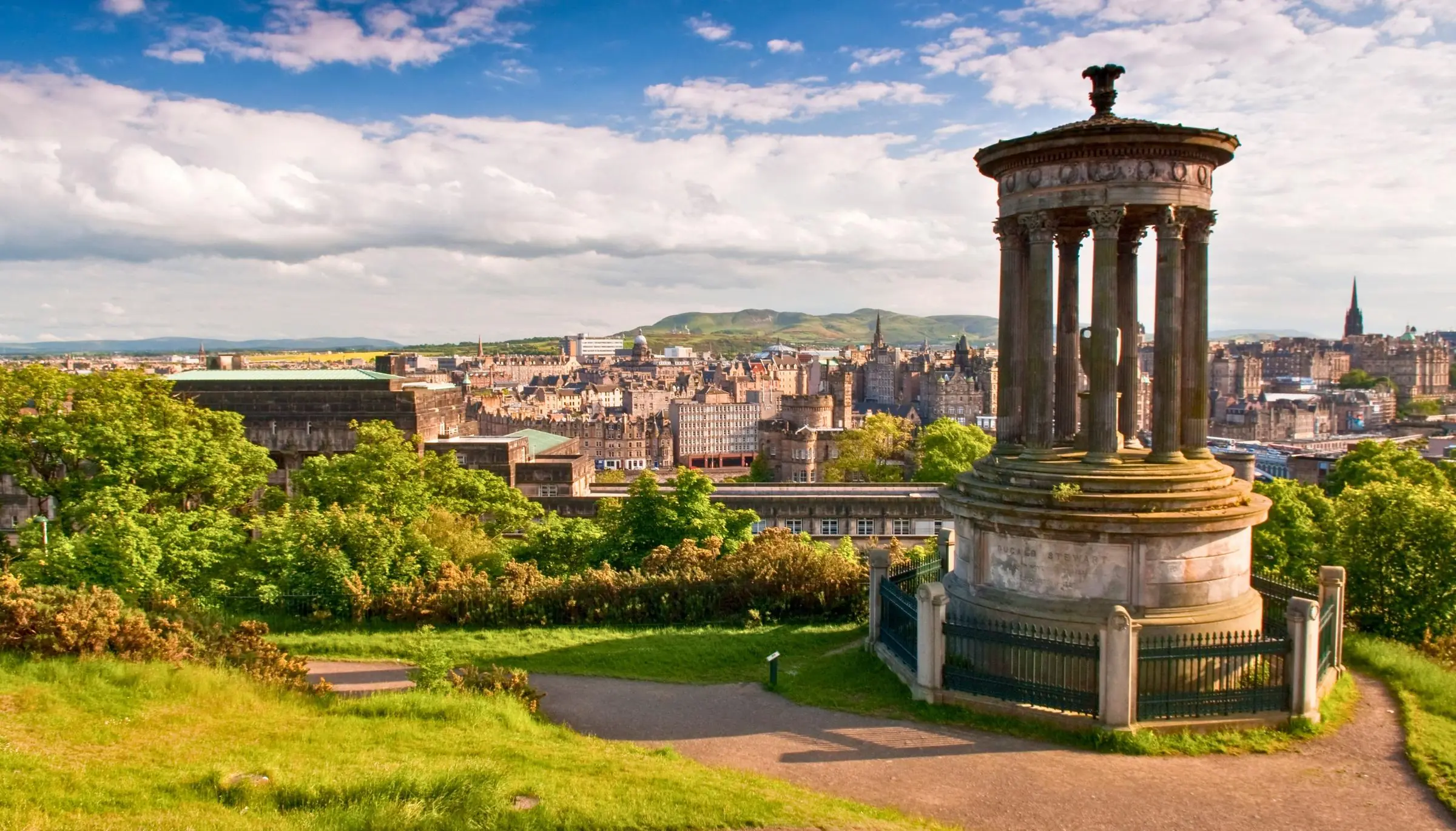
Rising just beyond the east end of Princes Street, Calton Hill is Edinburgh’s most accessible volcanic vantage point. Unlike the rugged, hours-long trek required to summit Arthur’s Seat, Calton Hill offers sweeping panoramic views of the city after a brief, five-minute walk up a paved path.
But you don’t just come up here for the views. The hill is covered in a bizarre, beautiful collection of 19th-century neoclassical monuments that collectively earned Edinburgh the nickname “The Athens of the North.” Today, it serves as a public park, an open-air museum, and the undisputed best spot in the city to watch the sunset.
This guide breaks down exactly how to get up the hill, what you are looking at once you reach the summit, and how to plan your visit around the crowds.
Who is Calton Hill Best For?
Calton Hill is one of the most universally appealing sites in Edinburgh, but how you approach it depends on your travel style.
- Time-Poor Travelers: If you only have 48 hours in Edinburgh, skip the massive hike up Arthur’s Seat and come here instead. You can walk up, see the monuments, take photos, and walk back down to the New Town in under 45 minutes.
- Photographers: This is ground zero for Edinburgh skyline photography. The alignment of the Dugald Stewart Monument with Edinburgh Castle in the background is the city’s most famous postcard shot.
- Budget Travelers: Access to the hill and the exterior of all the monuments is completely free. It is one of the best zero-cost activities in the city.
- Families with Young Children: The paved access road on the north side makes it easy to push a stroller to the top, and the wide, grassy summit gives kids plenty of room to run around safely away from traffic.
A Note on Wind: Because it is an exposed volcanic crag, Calton Hill is almost always windy. Even on a sunny July afternoon, you will want a light jacket or windbreaker when standing near the National Monument.
The “Athens of the North”
To understand Calton Hill, you have to understand early 19th-century Edinburgh. During the Scottish Enlightenment, the city’s intellectuals and architects were obsessed with classical antiquity. As the Georgian New Town was being built, city planners looked to Calton Hill to serve as their very own Acropolis.
Architects like William Henry Playfair and Charles Robert Cockerell were commissioned to design monuments that mirrored ancient Greece. The result is a slightly chaotic but visually striking collection of pillars, domes, and towers that dominate the eastern skyline.
Deep Dive: The 5 Iconic Landmarks
Once you reach the summit, there are five distinct structures and viewpoints you need to see.
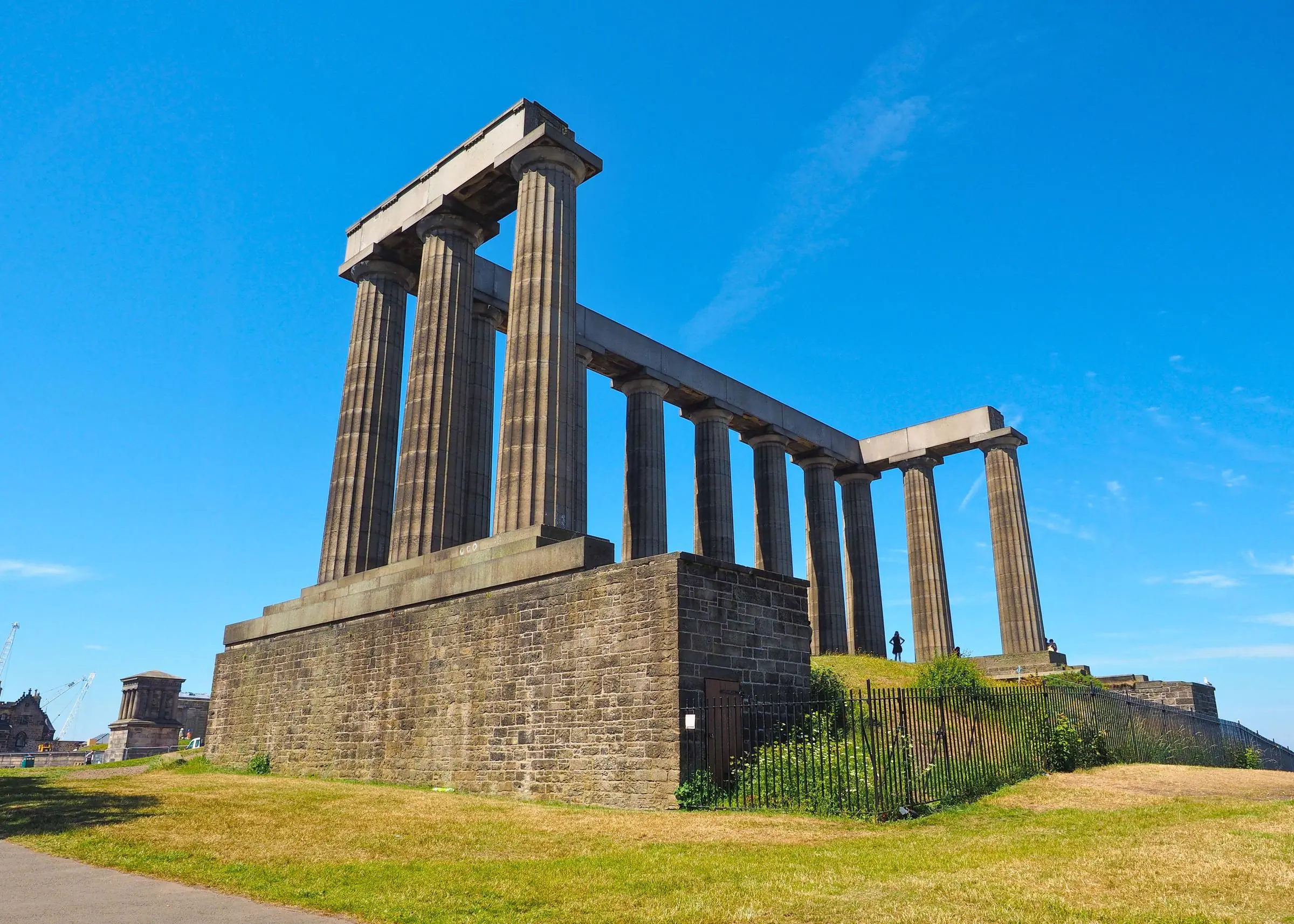
1. The National Monument (“Scotland’s Disgrace”)
Intended to be a memorial to the Scottish soldiers and sailors who died in the Napoleonic Wars, the National Monument was designed to be an exact replica of the Parthenon in Athens. Construction began in 1822, but the project was entirely reliant on public subscription.
By 1829, the funds dried up. Only twelve massive stone pillars and the architrave were completed. The project was abandoned, and locals quickly dubbed it “Scotland’s Disgrace” or “Edinburgh’s Folly.”
Today, it is the most popular structure on the hill. You will almost always see people climbing up into the monument to sit between the pillars.
Climbing Warning: The bottom step of the National Monument is deceptively high (nearly waist-height for an average adult). If you decide to climb up for a photo, watch your shins, and be careful coming back down—the smooth stone gets incredibly slippery when it rains.
2. The Nelson Monument
Built between 1807 and 1815 to commemorate Admiral Horatio Nelson’s victory and death at the Battle of Trafalgar, this tower looks distinctly different from the Greek structures around it. It was intentionally designed to resemble an upturned telescope.
In 1852, a large time ball was added to the top of the monument. It was synchronized with the firing of the One O’Clock Gun at Edinburgh Castle so that ships anchored in the Firth of Forth could accurately set their chronometers. The time ball still drops at exactly 1:00 PM every day (except Sundays).
- Climbing the Tower: For a small fee, you can climb the 143 steps to the viewing platform at the top. The stairwell is narrow and steep, but the 360-degree view from the top is the highest vantage point in the city center.
Nelson Monument Details
Tower Climb
- Open Monday to Saturday, 10:00 AM to 4:30 PM.
- 143 narrow steps (no elevator).
- Time ball drops at 1:00 PM precisely.
3. The Dugald Stewart Monument
This is the monument you have seen in every guidebook. Designed by William Henry Playfair in 1831, it honors the Scottish philosopher Dugald Stewart. The design is based on the Choragic Monument of Lysicrates in Athens.
You cannot enter the monument, but its placement on the southwestern edge of the hill makes it the perfect foreground subject for photos of the city skyline.
4. The City Observatory
Enclosed within a boundary wall on the top of the hill is the City Observatory complex. The main building, also designed by Playfair in 1818, looks like a Greek temple with a dome on top. For decades, this was the center of astronomical timekeeping in Edinburgh.
Today, the complex has been beautifully restored and is managed by Collective, a contemporary art organization. The grounds are free to enter, and the old transit houses have been converted into free exhibition spaces. The complex also houses The Lookout, a high-end restaurant with floor-to-ceiling windows offering spectacular views over the city.
5. The Panoramic Viewpoints
Calton Hill offers distinct views depending on which edge you stand on:
- West (Princes Street View): Stand behind the Dugald Stewart Monument. You will see the Balmoral Hotel clock tower, the Scott Monument, and Edinburgh Castle.
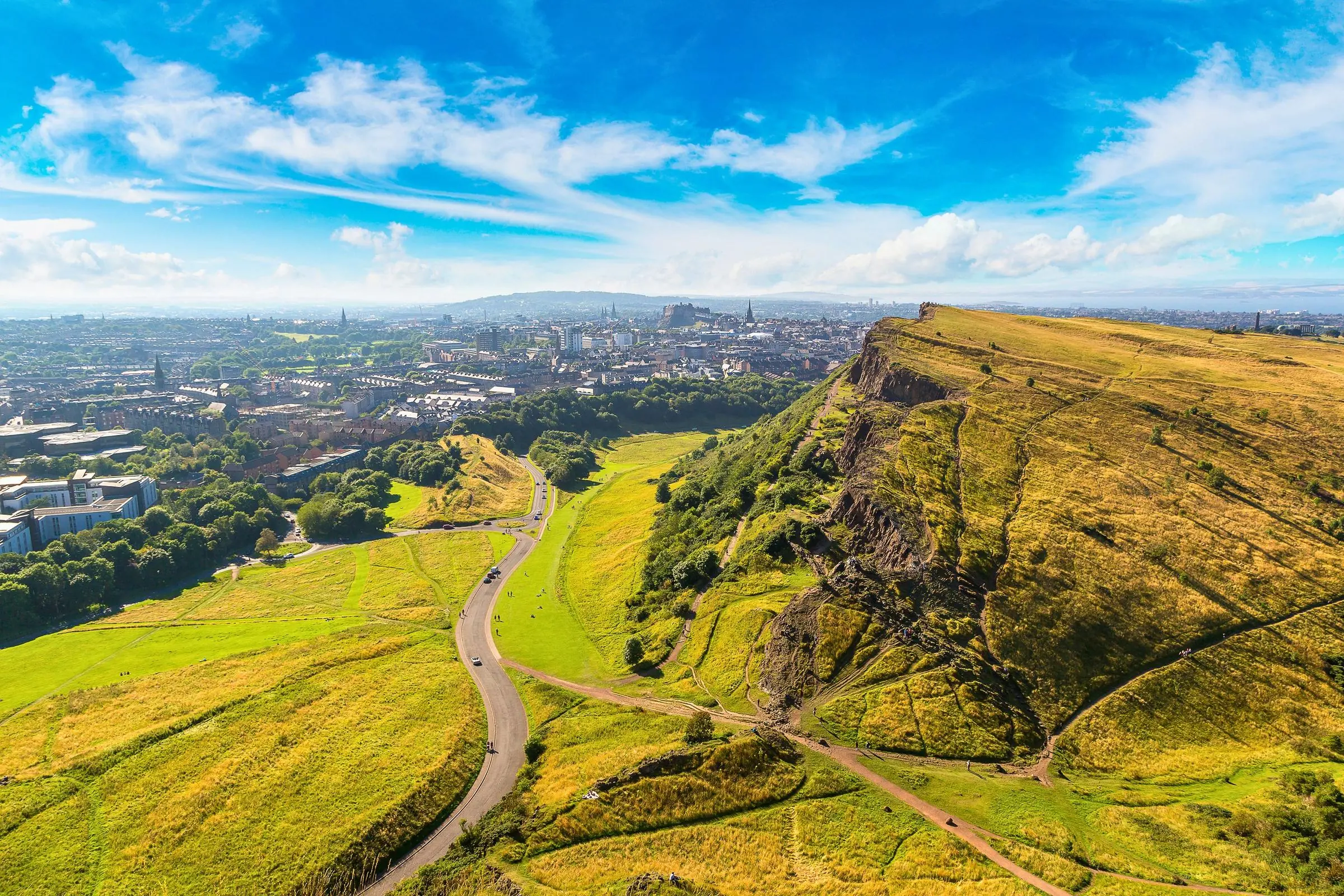
- South (Arthur’s Seat View): Look across the valley to the Salisbury Crags and the peak of Arthur’s Seat. You can also see the modern architecture of the Scottish Parliament and the Palace of Holyroodhouse.
- North (Leith & The Forth): Look down over the rooftops of the New Town toward the port of Leith and the waters of the Firth of Forth. On a clear day, you can see the hills of Fife in the distance.
Logistics: How to Walk Up Calton Hill
Getting to the top is straightforward, but you have two main options depending on your mobility.
Option 1: The Stairs (Fastest Route) The most common approach is from the south. Walk to the east end of Princes Street, cross over to Waterloo Place, and continue straight. Just past the Old Royal High School building, you will see a set of stone stairs on your left leading up the hill. This route involves a steep but short climb of about 3 to 5 minutes.
Option 2: The Paved Road (Accessible Route) If you are using a wheelchair, pushing a stroller, or simply want to avoid stairs, approach from the north. Head to Royal Terrace (near the intersection with Blenheim Place). Here, a wide, paved access road winds gently up to the summit. It takes about 10 minutes walking at a relaxed pace.
Public Transport: If you are taking the bus, numerous Lothian Buses (including the 1, 4, 19, 26, and 44) stop at “Waterloo Place,” right at the base of the southern stairs. If you are using the Hop-On Hop-Off Bus Tour, the Waverley Bridge or Regent Road stops will put you within a 5-minute walk of the hill.
Sunset Photography Tips
Calton Hill is the most photographed location in Edinburgh, and sunset is the peak time to be there. Here is how to get the best shot without getting frustrated by the crowds.
- Arrive Early: Do not show up exactly at sunset. Arrive at least 45 minutes prior. The best light (the “golden hour”) happens before the sun actually dips below the horizon, illuminating the stone of the monuments in a warm orange glow.
- The Classic Composition: To get the Dugald Stewart Monument in the foreground and the castle in the background, you need to stand on the paved path above and slightly to the right of the monument.
- Bring a Zoom Lens: A wide-angle lens is great for capturing the National Monument, but if you want the castle to look prominent behind the Dugald Stewart Monument, you need a telephoto lens (70mm to 200mm) to compress the background. If you use a standard smartphone wide lens, the castle will look like a tiny speck in the distance.
- Embrace the Crowds: The path behind the Dugald Stewart Monument gets packed with tripods. If you can’t get a clear shot, walk over to the National Monument and photograph the silhouettes of people climbing the pillars against the twilight sky.
Keep Planning: If you want to improve your travel photography, consider booking a Local Photogenic Spots Tour to learn the best angles from an Edinburgh resident.
Guided Tours and Hikes
While Calton Hill is easy to explore on your own, combining it with a guided hike provides much more context about the city’s volcanic geology and history.
If you want to tackle both of Edinburgh’s famous hills in one go, there are guided options that handle the navigation and pacing for you.
Hike Arthur's Seat & Calton Hill
- Guided hike covering both volcanic vantage points.
- Learn about Edinburgh’s geology and history.
- Paced for moderate fitness levels.
Professional Private Photoshoot
- Private photographer for your group.
- High-resolution edited images.
- Perfect for couples or family portraits on the hill.
Where to Stay Nearby
Staying near Calton Hill puts you right on the border of the New Town and the East End. This area is generally quieter than the Royal Mile but still within a 10-minute walk of Waverley Train Station and Princes Street. Look for hotels along Waterloo Place, Royal Terrace, or the top of Leith Walk.
FAQ
Is Calton Hill free to visit?
Yes, access to the hill, the public park, and the exterior of all the monuments is completely free. The only attraction that requires a ticket is climbing the interior stairs of the Nelson Monument.
How long does it take to walk up Calton Hill?
If you take the stairs from Waterloo Place, the climb takes about 3 to 5 minutes. If you take the paved access road from Royal Terrace, it takes about 10 minutes. Once at the top, most visitors spend 30 to 45 minutes walking around the monuments and taking photos.
Is Calton Hill wheelchair accessible?
Yes, the summit can be reached via a paved access road that begins at Royal Terrace on the north side of the hill. The paths around the summit are mostly paved or hard-packed gravel, making it accessible for wheelchairs and strollers, though some areas near the National Monument are grassy and uneven.
Are there public toilets on Calton Hill?
There are no dedicated public toilet blocks on the hill itself. However, if you are dining at The Lookout restaurant or visiting the Collective art gallery during their opening hours, facilities are available for patrons. Otherwise, use the facilities at Waverley Station before walking up.
Is Calton Hill safe to visit at night?
Calton Hill is generally safe during the early evening, especially around sunset when it is busy with tourists and photographers. However, it is a public park with limited lighting in some areas. It is best to stick to the main paved paths and avoid wandering the unlit grassy areas late at night.
Can you see the Edinburgh Military Tattoo fireworks from Calton Hill?
Yes. During August, Calton Hill is a popular free spot to watch the fireworks that conclude the Royal Edinburgh Military Tattoo at the castle. You won’t hear the music, but you get a fantastic view of the pyrotechnics over the city skyline. Arrive early to secure a spot along the western wall.